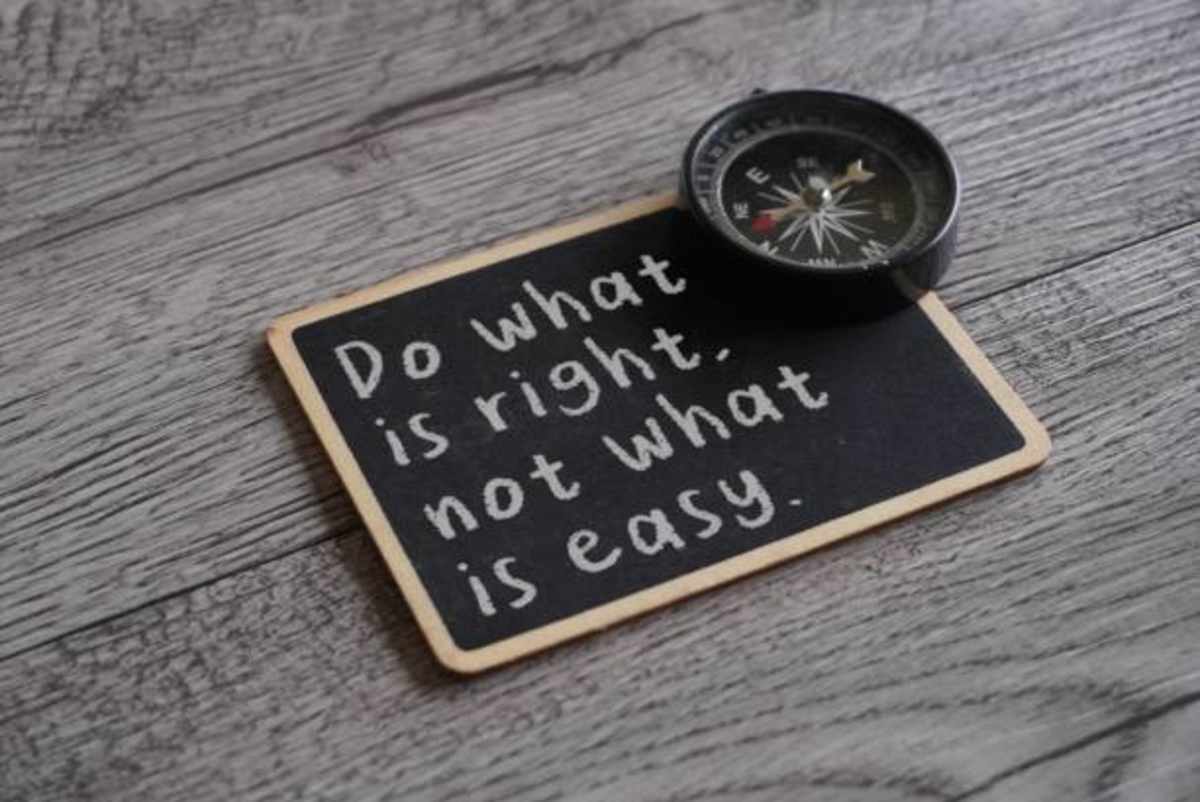
I must confess that the topic of morality is at the top of my list of interests along with the idea and art of asking questions. You may consider little if anything I have to say here even remotely controversial until we get to the chapter on the most rational and defensible foundation for morality. When I have shared my views on this topic with certain others in the past they haven’t known whether to consider me a heretic or a madman. Feel free to take your pick. LOL!
If asked to explain why I consider the topic of morality so important, I suppose my initial response would be that morality is the compass which guides our every action with regard to our fellow man.
If that compass is broken or out of whack, then a breakdown of personal relationships and eventually society at large is sure to follow. It’s a bit like a guidance system on a plane for flying at night or in low to no visibility circumstances. In other words, it is absolutely vital for anything which necessarily relies upon it.
We’ll have more to say about this in chapter three.
Let’s begin by attempting to offer a simple and understandable definition of what we mean by morality.
When dealing with a complex concept or idea it’s best to begin by defining one’s terms so that the listener will be able to follow along without getting lost in the weeds of misunderstanding.
Simply put, morality is the set of principles which distinguish between right and wrong and good and bad.
As is so often the case however, this does not get us all the way to an understanding of the idea of morality. It causes us to ask, what is ‘right’ and what is ‘wrong’ or what is ‘good’ and what is ‘bad’?
Essentially, answering one question has led us to four more. At this exponential rate we will never escape this intellectual maze.
Let’s see if we can simplify our search for understanding the concept of morality by a process of reduction.
The first thing to take notice of is that all four of these terms are subjective in nature. How is what is ‘right’ to be determined and who gets to do the determining?
These questions get to the heart of the matter and make it clear why this definition is unsatisfactory.
The problem with all words such as ‘right’, wrong’, ‘good’ and ‘bad’ is that they have no clearly discernable and objectively identifiable boundaries. Their boundaries can be moved by anyone who is in a position (of power or authority) to do so. They are not fixed, and this is the central problem with which we are faced in attempting to understand the idea of morality.
Boundaries are of an importance which most of us are appallingly unaware.
The saying ‘good fences make good neighbors’ applies just as much to language and ideas as it does to physical means of demarcation.
My simple definition of morality is ’the way we choose to behave towards others’. I will of course have much more to say about this when I attempt to make a case for the only rational and therefore defensible foundation for morality.
That is when things will get very interesting, for you and for me.
As I mentioned earlier when I explained that morality has no meaning for a person stranded alone on an island. Morality and ethics only make sense when more than one person is involved.
The reason this is the case is because morality is based upon property and ownership.
Before proceeding I believe it is necessary to explain how I understand property and ownership.
I don’t believe that anything may be considered property and thus owned by anyone which does not have clearly definable physical boundaries. We will later on address those elements which have legal protection as property but are not qualified as being so considered under my definition. You may already be thinking about some of those boundaryless elements
Now that you know how I view property and ownership we may proceed to explain what this has to do with morality.
I maintain that all of morality is based upon property and ownership. By this I mean that noting may be considered immoral which does not involve a violation of someone’s property rights.
I have a offered a longstanding challenge for anyone to point out to me something which is immoral but does not involve a violation of someone’s property or ownership rights. Numerous attempts have been unsuccessfully made. The reasons for the failures are varied but they have one important thing in common. They are all completely subjective and as such no agreement can ever be reached regarding what is immoral. This will never do.
Let me give a very recent example. The person who took up my challenge is one of those who considers my views on morality as those of a vile lunatic. I told you.
This person claimed that online bullying was immoral. I responded that while the behavior was a reprehensible and loathsome practice, it was not immoral.
For clarification I asked what he based his decision to call the behavior immoral. He responded that it was because it caused harm to another person.
This logic, while quite in vogue these days, has more holes than a slice of Swiss cheese.
Let’s start with the most obvious problem with this nonsensical notion.
What does one mean by harm? And, who gets to decide what constitutes harm? These are the simple questions which unravel what is claimed to be a supporting argument for the position.
The problem is one of boundaries. Harm has no clearly definable boundaries and can change based upon who has power and is in charge. This will never do.
First, the person who is being bullied is not being harmed in any ‘physical’ way. And secondly, they are a willing participant in the situation since they may avoid the venue where the bullying occurs or simply block those doing the bullying. They have a personal responsibility to avoid the emotional harm they are receiving but are refusing to take such responsibility.
Bullying is not immoral for the further reason cited earlier that it has no clearly defined boundaries. What constitutes bullying anyway. If one person says something negative about you, does that constitute bullying? Or are two or more people required to reach the definitional threshold? Also, what types of actions or words can be considered to be bullying.
This is the pathetic dilemma we find ourselves in today. If someone claims that the words or behavior of another have harmed them, then we are all supposed to believe them without a shred of evidence and simply upon their word. Consequently, we are expected to punish the person who is purported to have harmed them. This is madness.
Let me offer up a couple of hypotheticals in order to illustrate my contention.
Let’s say that you and I are in love with a piece of property overlooking a lake somewhere. We are both trying to buy the property from the owner. I manage to convince the owner to sell the land to me. You are devastated when you receive the news. Very shortly thereafter you become seriously depressed. Have you been harmed? If so, by whom? Me? The property owner? Both of us? You can see readily enough just how ridiculous this is.
Let’s say that you are my black neighbor. In the course of our conversation, I call attention to some statistics. Blacks comprise roughly 13 % of the US population but are responsible for approximately 65 % of all violent crimes. You take offense at this; claim you have been harmed and accuse me of racism. So what, are facts now to be considered weapons?
I believe it is obvious from these two examples as it would be as well with hundreds of others which might be offered that such things cannot be referred to as harm, and most certainly cannot credibly be considered immoral.
To state the problem again, there are no clear boundaries in these cases which can separate harm from non-harm. No one can discern the difference objectively and will simply adopt the opinion which they prefer.
That is why the only rational and defensible basis for morality is property (which has clearly defined physical boundaries) and ownership.
Let me explain in a bit more detail just what I believe constitutes property and ownership.
It all begins with self-ownership. You and you alone own yourself. No other person or group of people can own you. When the law claimed that one person might own another, it was an empty claim. One person certainly may imprison or enslave another, but that in no way constitutes ownership. If it did then we could claim that prisoners of war might be owned by their captors. Or that people incarcerated for a crime might be owned by the state or government who incarcerated them. This is sheer nonsense.
So, each of us own ourselves. Any physical property (it must have clearly defined physical boundaries) may become acquired and thus owned by us through various procedures.
We may buy it from the previous owner as in the case of the lake property I acquired. We may trade something for it. I give you a chicken for some of your arrow heads. We might inherit it from my parents or other relatives. Finally, I come across a piece of property that no one has claimed ownership of.
In each of these cases physical property has been acquired peacefully and with violence or threat of violence. Thus, all such transactions are moral.
It is perhaps worth pointing out that when one becomes the owner (through any of these procedures) of a piece of physical property he has in fact become the possessor of the right not only to use the property or dispose of it as he sees fit, but also the right to exclude others from any use of it. It is this exclusivity that defines ownership. Ownership is exclusivity, pure and simple.
Every immoral act from rape to robbery is a violation of someone’s property and ownership rights. If no property or ownership rights are violated, then nothing immoral has occurred. It really is that simple.
From trespassing to carjacking, all of these acts are immoral because they violate the property rights of the person who owns the property in question.
Now let’s turn our attention to some things which are considered property but, failing to meet our clearly defined physical boundary rule, really do not constitute property at all and thus there is nothing immoral, and there shouldn’t be anything illegal about usurping or taking them whenever we are so inclined.
The things I have in mind obviously are what are currently erroneously referred to as ‘intellectual property’ and ‘reputation’.
Let’s begin with IP. If you write a book as I have done numerous times and I take a hard copy or disc copy of the book, then I have committed theft and violated your property rights. That would be immoral.
If on the other hand I simply copy some portion of the book and then return the book to you, I have committed no theft and have not violated your property rights. Thus, nothing immoral has occurred.
If I borrow a cd of your music from you and rip a copy of it form myself and then return the cd to you, no theft of violation of property rights has occurred. There is nothing immoral in my having done so.
When a person does so, and then sells copies at reduced rates to others, he is engaging in bootlegging. This may be deemed illegal and immoral, and laws may be passed saying as much. The truth however is that these laws like those purported to have allowed one person to own another are empty and meaningless.
The laws I have been referring to here are known as copyright laws. Some have attempted to make the case that the bootlegger deprives the creator of the books or music of earnings. This may or may not in fact be the case. Either way it is irrelevant. Furthermore, there is no way to prove that any of the people who purchased the bootleg version would have ever paid full price for the original version. This is pure speculation and nothing more. It is essentially an argument that the bootlegger has deprived the originator of possible or potential earnings. Possibilities and potentialities may not be owned since they are in no one’s possession.
Let’s approach this from a different angle. If you write a book or a song, how much alteration would I need to make in order to escape a charge of copyright infringement? Let’s say the book has 12,000 words. If I changed 6,000 of them, would that still be considered copyright infringement? What if I changed 11,800, would that still be considered copyright infringement. You see, we are right back where we started face to face with a lack of clearly defined boundaries. Thus, all claims of copyright infringement are determined by a judge based upon his own interpretation of the matter and without a shred of objective evidence to justify it. It’s simply his word on the matter. This is nonsense on stilts.
The same holds true for patents as well. You concoct a formula XYZ for eradicating acne. I copy your formula and make a few alterations. What percentage of the formula must I alter to avoid patent infringement? 10%, 50%, 80%? There is no correct answer and again the matter will be at the mercy of some unelected judge somewhere. This is more nonsense on stilts.
Let’s consider the issue of trademarks. Trademark laws are both unjustified and unnecessary. If I represent myself as a brand name in order to sell you a knockoff product, then I have engaged in fraud, which is a property violation (theft by deception) and is already punishable by law. It is also immoral to defraud someone.
As a side note, Leonardo da Vinci probably invented more things than anyone who has ever lived and he did not patent one thing. I bring this up because some people argue that without patent protection inventors would not invent and without copyright protection artists would not create. This is an argument without evidence.
Now let’s turn our attention to the topics of liable, slander and blackmail.
Each of these is considered a crime and legislation has been passed to say they are. Again, laws without justification should be either ignored, or better yet, repealed.
The reason is the same as I cited in the previous cases. It is the lack of clearly defined boundaries, property and ownership rights.
How in the world can it be seriously maintained that a person owns their reputation? More nonsense on stilts. Consequently, who decides when a person has been slandered or liabled? Again, an unelected official somewhere based solely on his whim, as there is no other criteria apart from subjective opinion. I hope you are beginning to realize just how much mischief results from such ridiculous and unjustified notions and laws.
A reputation is the perception held regarding a person by other people. We cannot and should not attempt to control their perception. They have a natural right to it and may rely on whatever sources they choose to inform that perception.
Let’s talk next about blackmail. This is the situation where someone threatens to make some piece of information public which may prove harmful to the subject in question if he refuses to pay a fee. This is considered to be extortion, but where is the property or ownership violation? That’s correct, there isn’t any. Thus, it is not immoral and should not be illegal.
Let’s say that you have taken pictures of me with a woman other than my wife. Perhaps I am a public figure. You threaten to share the photos with a news outlet unless I pay you $10,000.00. You have not violated my property or ownership rights. And I am perfectly free to ignore your threats if I choose to do so. If I were wiser, I would have understood that just such a thing was possible if not likely and conducted myself accordingly. A person who is unfaithful is deserving of having his unfaithfulness exposed and suffering the consequences.
Hopefully at this point you have understood the only foundation for morality which I consider rational and defensible.